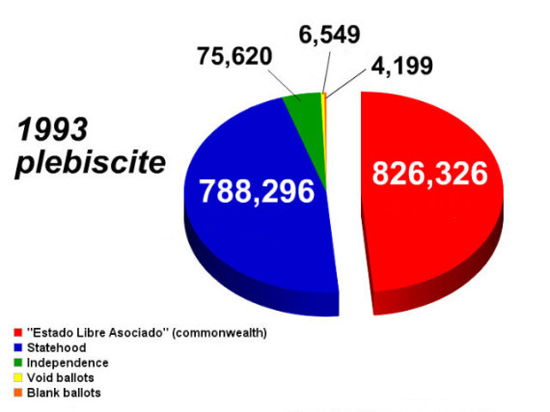
The current political status of Puerto Rico is officially called Estado Libre Asociado de Puerto Rico. When it is literally translated into English, it means Free Associated State of Puerto Rico. Over time, supporters of this political status have conveniently referred to it as the Commonwealth of Puerto Rico. Territorial status is meant to be a transitional step to usher in a permanent status, such as statehood or independence. Established in 1952, the territorial arrangement it was meant to serve as a transitional step to something greater.
In the 1980 Harris v. Rosario case, The Supreme Court of the United States acknowledged that Puerto Rico fell directly under the territorial clause of the U.S. Constitution and under the authority of Congress: “Congress, pursuant to its authority under the Territory Clause of the Constitution to make all needful rules and regulations respecting Territories, may treat Puerto Rico differently from States so long as there is a rational basis for its actions.” In effect, Congress has the authority to regard The Commonwealth of Puerto Rico as an ordinary territory and treat Puerto Rico in a different and unequal way from the other 50 states. In other words, Puerto Rico is a colony of the United States of America.
This current colonial status does not allow Puerto Ricans to vote for the President of the United States. Puerto Ricans do not have representation in the U.S. Senate and no voting representation in Congress. Instead, the 4 million U.S. Citizens of Puerto Rico only have one “Resident Commissioner” who cannot even vote on the House floor. Therefore, Puerto Ricans have no say in the making of the laws and statutes that apply to them. Even though the U.S. Supreme Court has absolute jurisdiction over Puerto Rico, Puerto Ricans do not have representation in the U.S. Senate to cast an up or down vote on Supreme Court nominees. In the end, Puerto Rico is governed by a Congress in which they are not allowed to participate in, an Executive whom they did not elect, and a Judiciary whose justices they did not confirm.
The 4 million U.S. Citizens of Puerto Rico are not allowed to fully participate in the democratic process of their nation. Consequently, they are the victims of political discrimination. The people of Puerto Rico are treated as disenfranchised and second-class U.S. citizens.
The United States of America is supposed to be a free and democratic republic, not an empire. All of its citizens should be entitled with the right to pursue the American dream.